> For the complete documentation index, see [llms.txt](https://docs.formsort.com/llms.txt). Markdown versions of documentation pages are available by appending `.md` to page URLs; this page is available as [Markdown](https://docs.formsort.com/core-concepts/versioning-in-formsort-deploying/variant-revisions.md).
# Variant revisions
## Variant Revision UUID
When you [deploy](/core-concepts/versioning-in-formsort-deploying.md#deploying-your-flow) or redeploy a variant to any environment (e.g., Production or Staging), Formsort creates a unique 36-character `variant_revision_uuid`. This UUID represents the exact state of the variant at the time of deployment and can be found in the **History** tab of the variant.
### Pinning
When a responder loads a flow and begins interacting with it, a `variant_revision_uuid` will be loaded based on the `responder_uuid` cached in their browser. This “pins” the responder to that exact variant revision on return visits, ensuring a consistent experience in terms of content, style, and logic.
This pinning behavior helps maintain:
* A seamless experience for returning users
* Cleaner cohort analysis, since responders in-flight on older revisions won’t be affected by new deployments
To bring responders onto the latest revision, see [**Superseding existing versions**](/core-concepts/versioning-in-formsort-deploying.md#superceding-past-revisions-of-a-variant).
#### Preventing pinning
There are two main ways to bypass variant pinning:
* Enable **Start each session as a new responder** in your variant settings
* Use your browser’s **incognito mode**, which doesn’t store `responder_uuid` during incognito sessions
{% hint style="info" %}
💡 **Pro tip:** Testing a recent change but still seeing an old version? Open the form in an incognito window to make sure you're seeing the latest deployed revision!
{% endhint %}
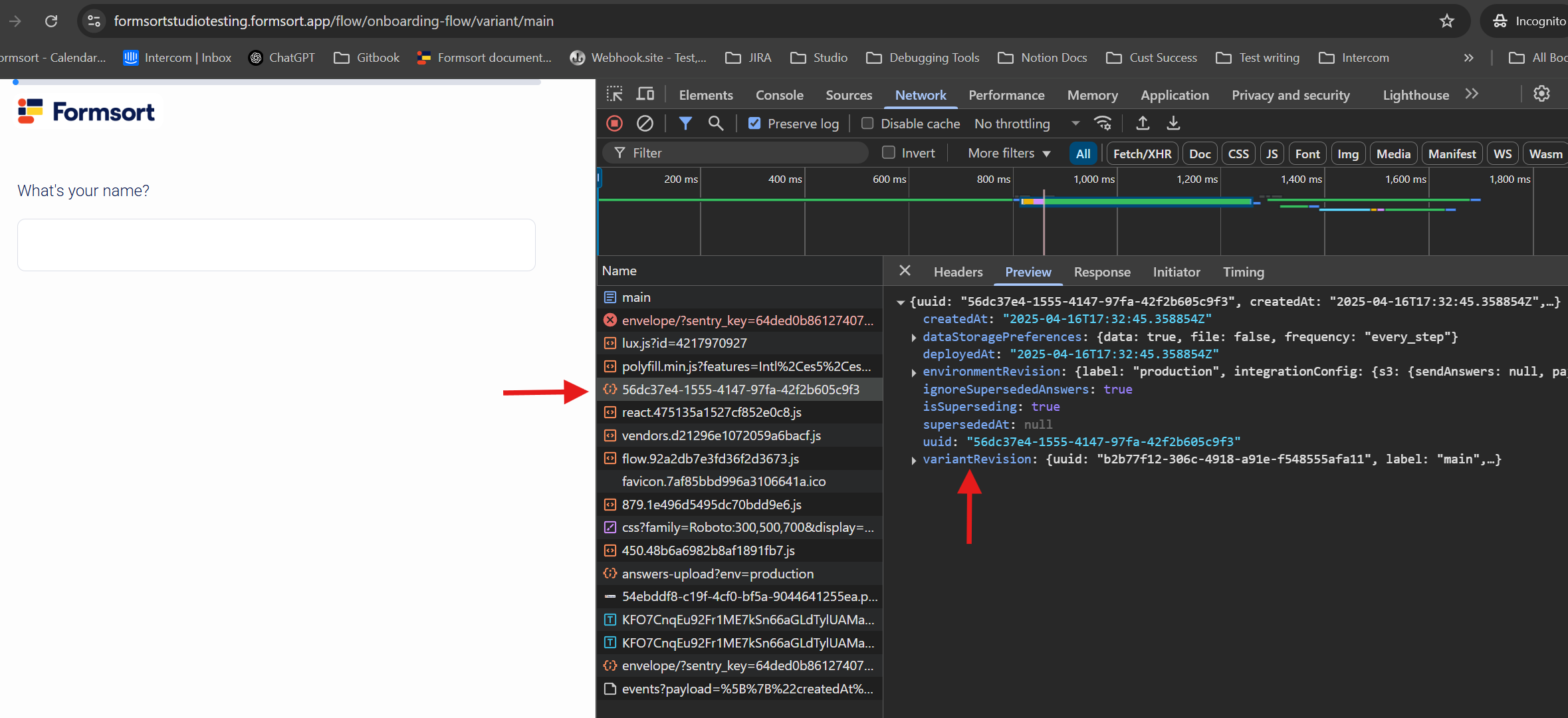
### Checking Variant Caching
If you’re troubleshooting and want to confirm which variant revision is cached:
1. Open your live flow.
2. Right-click anywhere and select **Inspect** to open your browser's developer tools.
3. Go to the **Network** tab.
4. Look for a fetch request with the name of the variant deployment ID.
5. In that request, you’ll find the `variant_revision_uuid`.
{% hint style="warning" %}
You may need to reload the page after opening the **Network** tab—the fetch call is made **once** when the flow **initially loads**.
{% endhint %}
***
### Force‑Loading a Specific Revision
If you need to test or share an exact revision, append the `variantRevisionUuid` parameter to your form’s URL:
```http
https://your-form-url?variantRevisionUuid=YOUR_UUID_HERE
```
Replace `YOUR_UUID_HERE` with the target revision’s `variant_revision_uuid`.
{% hint style="info" %}
💡 Use this sparingly—hardcoding a revision UUID bypasses the normal publish workflow and can prevent future live updates from taking effect.
{% endhint %}
---
# Agent Instructions
This documentation is published with GitBook. GitBook is the documentation platform designed so that both humans and AI agents can read, navigate, and reason over technical content effectively. Learn more at gitbook.com.
## Querying This Documentation
If you need additional information that is not directly available in this page, you can query the documentation by asking a question.
Perform an HTTP GET request on the following URL with the `ask` and `goal` query parameters:
```
GET https://docs.formsort.com/core-concepts/versioning-in-formsort-deploying/variant-revisions.md?ask=&goal=
```
`ask` is the immediate question: it should be specific, self-contained, and written in natural language.
`goal` is what the user is ultimately trying to achieve, the reason they need the answer. Sharing it helps GitBook give you a better, more relevant answer. A goal is most helpful when it describes the outcome the user wants rather than restating the question. For example, with `ask=how do I create an API token`, a goal like `automate deployments from our CI pipeline` lets GitBook tailor the answer to that use case.
The response will contain a direct answer to the question and relevant excerpts and sources from the documentation.
Use this mechanism when the answer is not explicitly present in the current page, you need clarification or additional context, or you want to retrieve related documentation sections.